Can I Quiet My Soul in God’s Presence? Psalm 131

The quiet before the storm is ushered in when the forecast is finally settled. When my home was once again in a tropical storm’s predicted path in September 2021, life got upended. Decisions were suspended, and I waited. A heavy hush fell in the waiting room where I had gathered my supplies. Will this unwelcome guest rake havoc on my area? Will he overstay his welcome? Will my little portion of the piney woods see long-term damage? Questions roll in waves: uncertainty ebbs and flows.

Psalm 131 was written to be read aloud by those who were making their yearly pilgrimage to Jerusalem. This arduous trek would have involved steep inclines and desert wanderings. God’s people needed encouragement to keep going and to prepare themselves for an encounter with God in the Temple.

1 O Lord, my heart is not lifted up; my eyes are not raised too high; I do not occupy myself with things too great and too marvelous for me. 
Psalm 131:1 ESV

Planning

I am a planner. I love to make plans and predict what will happen next. My heart and eyes focus on the next thing, the next challenge, and the next worry. When I do this, is it because my eyes are straining beyond what God has for me now? Am I missing the quiet before the storm because the noise in my head is drowning out God’s presence? I know it is easy for me to catastrophize about what I think I see ahead. I try to figure out my disaster plan and response before anything goes wrong. Instead, the psalmist chooses not to occupy himself with things too marvelous for him. Where I focus my mind and heart are my own choices.

What if, now that I have gathered my storm supplies, I take some time to sit with the Lord and see what He has for me in this time of waiting? What if I set a timer and sat quietly before him and listened? (For me setting a timer creates a gentle boundary to keep my focus on the Lord.)

2 But I have calmed and quieted my soul, like a weaned child with its mother; like a weaned child is my soul within me. 
Psalm 131:2 ESV

Be Still and Snuggle

My youngest grandchild, Ian, is a snuggler. He loves to be rocked to sleep and held. While his older sister is quick to wriggle out of my arms, he is content to settle in. Nothing is more calming on earth than a child sleeping peacefully on your chest.

Can my soul snuggle up with God this day and rest peacefully, knowing God has a plan? Can I push pause on the doing, going, getting, and achieving for even fifteen minutes? Can I choose to quiet my soul in this waiting time? The psalmist is creating a peace-filled liturgy for himself. He is singing a lullaby over his soul.

3 O Israel, hope in the Lord from this time forth and forevermore.
Psalm 131:3 ESV

In the final verse of Psalm 131, the psalmist gives me a glimpse of the future. Hope in the Lord is available for me now and forever. However, in the quiet before the storm, will I be found in my father’s arms at peace in that hope or pacing around as if it all depends on my efforts?

Prayer

Lord, please help me quiet my soul and come more completely into your presence. Could you help me to release my concerns and plans and rest in your arms? Thank You for always being available and never being too busy for your daughter. In the name of the Father, the Son, and the Holy Spirit. Amen

How do you quiet your soul?

When the Enemy Surrounds Me – Psalm 57

Rescuing our teddy bears topped the list of goals for my sister and me when water began to fill our car one Sunday afternoon years ago. We rapidly employed the screaming while holding our bears aloft technique. No doubt my father, the driver, really appreciated his children’s skills. Nevertheless, we were loudly lamenting the peril we had before us.

Gentle rain is a hallmark of the British countryside, but steady and persistent downpours created a flash flood that caught my father by surprise. Somehow, within a very few minutes of encountering the deep water, our car was pulled to safety by a helpful farmer and his tractor. Some very kind Gypsies or Travelers welcomed us into their camp, gave us hot cups of tea, and dried our clothes by open fires. As a five-year-old, I considered this all to be a grand adventure.

David spends a great deal of time trying to outrun the wrath of King Saul. Psalms of lament, like Psalm 57, express honestly and passionately feelings of being persecuted, isolated, and in actual peril.

Be merciful to me, O God, be merciful to me, for in you my soul takes refuge; in the shadow of your wings, I will take refuge, till the storms of destruction pass. Be exalted, O God, above the heavens! Let your glory be over all the earth! I cry out to God Most High, to God who fulfills his purpose for me. He will send from heaven and save me; he will put to shame him who tramples on me. God will send out his steadfast love and his faithfulness! My soul is in the midst of lions; I lie down amid fiery beasts—the children of man, whose teeth are spears and arrows, whose tongues are sharp swords. Be exalted, O God, above the heavens! Let your glory be over all the earth!  (Psalm 57:1-5 ESV)

When faced with an enemy, what does David do?

  • Asks for mercy and takes refuge in the shadow of God’s wings while the storm of destruction rages.
  • He stands in peace before the God Most High. He acknowledges that God will fulfill his own purposes with David’s life. Even when the outcome seems uncertain, God’s prevails.
  • He speaks confidently about God as one who will send and save, one who will bring justice, and one who will send out steadfast love. He speaks of it before it happens because he knows God’s character.
  • He laments by composing a list of the circumstances coming against him: storms of destruction, lions, fiery beasts, sharp-tongued swords, spears, and arrows.
  • He knows when to rest. Once the lament has been delivered, David lies down amidst the fiery beasts in full confidence of his rescue.
  • Finally, he prays for God to be glorified and exalted all over the earth. It is a prayer of confident surrender.

I have never been chased down by a murderous king. However, I do know about the enemy of my soul, who is described in scripture as a prowling lion (1 Peter 5:8). When the enemy marshals his forces against me, I can feel like David. The storms of destruction surround me, and all I can see are fiery beasts and sharp swords. My first inclination is not always to cry out to God for mercy. I might look a lot more like a child gripped by fear screaming in the backseat of a car.

I long to be like David, declaring faithfulness against the din of my fears. Shouting out the truth of God’s promises. He will rescue me, he will send help, and he will bring justice. There is power in declaring truths aloud so I can hear them. Finally, can I stop striving and pray a prayer of confident surrender. David lies down and so can I. I know God’s efforts and work provide all that I need even when I find myself surrounded by enemies.

Prayer

Lord, I cry out to you because you are the God Most High, and no one is above you. You, God, fulfill your purposes for me. You will send from heaven and save me. You will rescue me into your presence in Heaven or preserve my life on earth. You will put to shame him who tramples on me. God, you will send out your steadfast love and your faithfulness! My soul may be in the midst of lions; I may even lie down amid fiery beasts, but you will be exalted, O God, above the heavens! Let your glory be over all the earth! Let your will be done here and in Heaven, Amen.

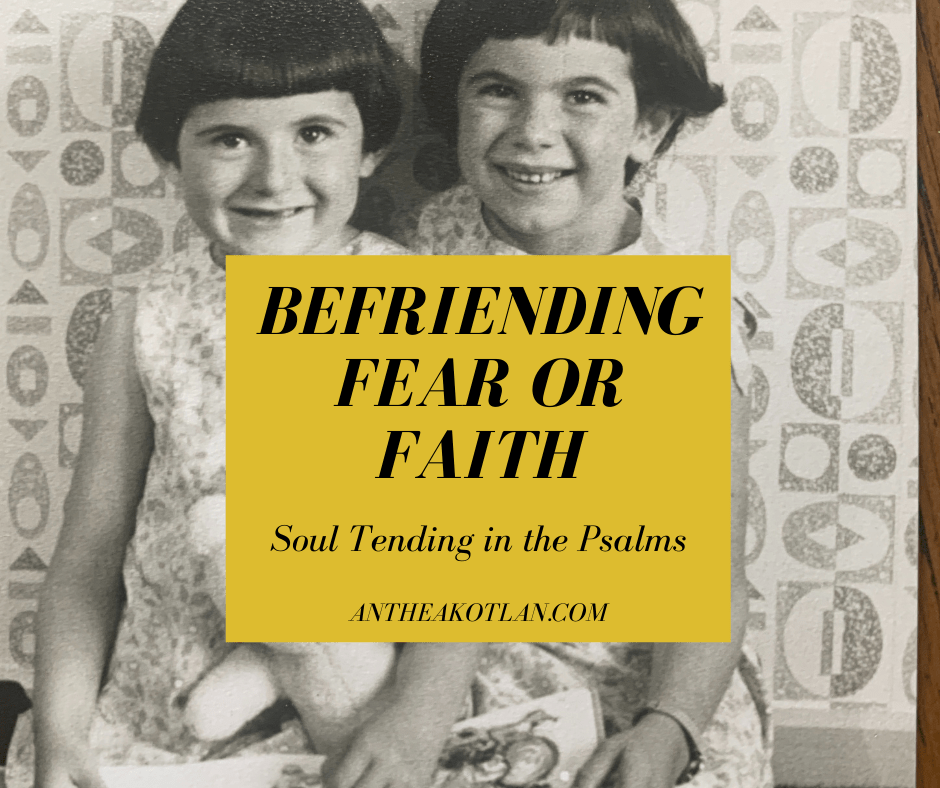
Befriending Fear or Faith? Psalm 37:1-5

A circa 1970 pic of my sister and I with atrocious bangs. (I’m the one on the left.)

Was she asleep?

My four-year-old brain struggled to process what had occurred. We were sitting outside the Tutbury* Police station when my mother slumped backward at an awkward angle while her sunflower yellow dress threatened to capsize over her head. I tried smoothing it down and calling to her as people rushed past us.

Earlier that day, she had lost her gold watch. A potent blend of fear of my father’s rage and regret over the loss overwhelmed her, causing the fainting spell. Eventually, a policeman came to our aid with smelling salts.
Fear and fretfulness were part of my daily life growing up.

What do I do when I feel fearful?

Fret not yourself because of evildoers; be not envious of wrongdoers! For they will soon fade like the grass and wither like the green herb. Trust in the LORD, and do good; dwell in the land and befriend faithfulness. Delight yourself in the LORD, and he will give you the desires of your heart. Commit your way to the LORD; trust in him, and he will act.
Psalm 37:1-5 ESV

As an adult, I have a tendency to fret. If there was a fretters’ anonymous group, I might be a member. But, instead, fretting is anxiously anticipating my own inabilities.

  • What if I make a mistake?
  • What if I don’t have enough time?
  • What if I forget?
  • What if I fail in some way that cannot be redeemed?

Fretting is to worry, and it can also mean to wear away at something by rubbing or gnawing. Obsessively fretting can certainly wear a groove in my mind that is all too easy to find and get back to over and over.

Reviewing a past event on repeat leads to a cycle of unending questions.

  • Did I say the right thing? What if I offended her?
  • Did he misunderstand me?
  • Do I need to go back and explain?
  • Often fretting is self-focused, but sometimes it lends itself to comparison.

Fretting about other people’s actions that I simply can’t control is a sign of a lack of boundaries on my part. How often have I worried about other people’s feelings that I could do nothing to fix? (Can you tell I’m reading the bestseller Boundaries?)

In Psalm 37, the psalmist offers an antidote for fretting.

Dwell in the land and befriend faithfulness.

Psalm 37:3 ESV

Dwell

This word means to remain, stay, linger, and be still. When fear takes the upper hand in my life and triggers a cycle of fretfulness, dwelling in God’s presence brings a needed pause.

Befriending faithfulness

How do I make friends with faithfulness? Spending time focused on my faith and, in so doing, building it up like a muscle. For me, that might mean making a list of blessings. It is all too easy for me to see the glass of my life as half full when it is, in fact, overflowing in ways that I might overlook right away. Reading and reviewing God’s word and seeking his promises can also change my perspective. The next few verses of Psalm 37 are rich with promises of how God will champion me as I choose to focus on faith and let go of fretfulness.

4 Delight yourself in the LORD, and he will give you the desires of your heart. 5 Commit your way to the LORD; trust in him, and he will act.
Psalm 37: 4-5 ESV

Prayer

Lord, will you help me to delight in you and commit to your ways of doing life? Give me the ability to trust more and be fretless. Rewire my default setting. May I be found to be befriending faithfulness at every opportunity you kindly lay before me? Amen.

How about you, how do you friend faithfulness in the face of fear?

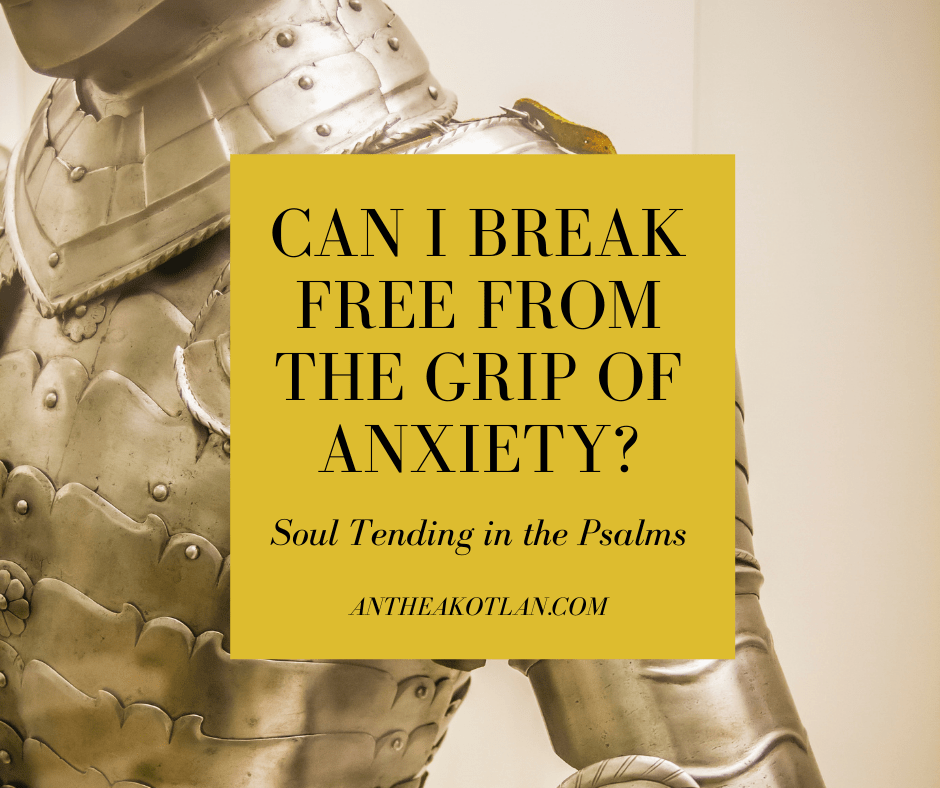
Can I Break Free from the Grip of Anxiety? Psalm 13

The armor of God


The Oxford dictionary defines anxiety as: “a feeling of worry, nervousness, or unease, typically about an imminent event or something with an uncertain outcome.”

My childhood was steeped in a tradition of ominous concern for all outcomes. My mother is particularly gifted in creating worst-case scenarios. She was an apocalyptic prepper long before it became trendy.
Honestly, my inheritance of anxiety has been nourished and watered by me for many years. It’s a hard habit to break. My default setting is to worry first and pray later. I must intentionally surrender my fears and anxieties to God.

Does anxiety have a paralyzing grip on me?

Anxiety leaves me feeling small and weak and quite focused on myself.

Psalm 13 is a psalm of lament. The author feels desperate and without hope. I believe psalms of lament provide a liturgy for processing through feelings of deep sadness and fear. As I read the first two verses of Psalm 13, I notice the author feels overwhelmed with a state of lack and longing. Telling God exactly how I feel is never a problem. Crying out to him provides a chance to process my feelings, and that is the only healthy way to process them.

1 How long, O Lord? Will you forget me forever? How long will you hide your face from me?2 How long must I take counsel in my soul and have sorrow in my heart all the day?How long shall my enemy be exalted over me?
Psalm 13:1-2 ESV

In these opening verses, the psalmist expresses frustration with delay. “How long?” is a question focused on what I don’t have. I want a right now solution. The psalmist focuses on what he believes has not been considered or attended to by God. Have I questioned God’s timing on solving a problem I have prayed about? Choosing to believe that I am not getting what I deserve, and God is neglecting me, may cause me to become spiritually vulnerable to the enemy’s deceptions. I can choose to stop feeding the anxiety beast and stop focusing on what I don’t have.
How long? The real answer to that question is when it’s the best time according to God. The ideal timing of God’s provision for anything I ask for is based on things I don’t even know that I don’t know. Releasing my urgent need to know, brings freedom and peace.

The question in verse 2 feels like it was taken directly from my own life. “How long must I take counsel in my soul and have sorrow in my heart all the day?”

Have I taken counsel or advice only from myself at times? Yes.

I believe that God designed us to thrive in community. Isolation can lead to seeking advice based solely on my own experience. Sometimes I need a fresh perspective from a godly friend or mentor. All too often, isolation can lead to sorrow or even depression. I can feel isolated in a room full of people. One lie that I have believed at times is that I am the only one to have experienced something. Or I am the only one to have made such a terrible mistake. There is very little new under the sun. If I am willing to be vulnerable with a trusted friend or family member, I might find someone else who can help me carry the burden, because he or she has traveled this road as well.
The second part of verse 2 asked about my enemy. Who is my enemy? The person who cut me off in traffic. The family member who betrayed my trust. The church leader who failed me when I needed her help the most. In the pain of the moment, any human may play a role.

Who is our real enemy?

“For we do not wrestle against flesh and blood, but against the rulers, against the authorities, against the cosmic powers over this present darkness, against the spiritual forces of evil in the heavenly places.” Ephesian 6:12 ESV
My true enemy is Satan, and he utilizes spiritual forces that trespass into heavenly places. The good news is that God has provided the ultimate victory for us through the death and resurrection of Jesus Christ.
In Ephesians chapter 6, Paul goes on to challenge us to put on our spiritual armor.
13 Therefore take up the whole armor of God, that you may be able to withstand in the evil day, and having done all, to stand firm. 14 Stand therefore, having fastened on the belt of truth, and having put on the breastplate of righteousness, 15 and, as shoes for your feet, having put on the readiness given by the gospel of peace. 16 In all circumstances take up the shield of faith, with which you can extinguish all the flaming darts of the evil one; 17 and take the helmet of salvation, and the sword of the Spirit, which is the word of God, 18 praying at all times in the Spirit, with all prayer and supplication. To that end, keep alert with all perseverance, making supplication for all the saints…Ephesians 6:13-18 ESV

When do I need to put on my armor?

We are called to suit up daily with the armor of God. Pray through each piece of armor and ask God to provide this for you and those you love. Carefully pray each verse and imagine you are putting each piece on.

  • Fasten on the belt of truth
  • Put on the breastplate of righteousness,
  • Put on the shoes for your feet, the readiness given by the gospel of peace.
  • Take up the shield of faith
  • Put on the helmet of salvation,
  • Carry the sword of the Spirit, which is the word of God

What are the benefits of using the armor of God?

Suiting up with God’s armor will break the grip anxiety has on our minds and hearts. Putting on the armor will also free us up to accomplish some important kingdom-building work.

  • Praying at all times – continually praying throughout the day and night
  • Praying in the Holy Spirit – letting God guide our prayer agendas • Keeping alert –avoiding distractions
  • Persevering— keep going• Receiving a renewed opportunity to pray for other Christians

Prayer

Thank you, Lord, for your provision in times of fear and uncertainty. It is far too easy for me to allow anxiety to overwhelm and isolate me. Help me to cry out to you first and foremost. Help me to seek God’s counsel from friends and family. Remind me daily to put on the spiritual armor you have so generously provided. Help me to walk daily in greater freedom by surrendering every fear to you. In Jesus’ name, Amen.

Have you read the headlines? Psalm 14

  • An earthquake-ravaged a country previously devastated by anarchy and poverty.
  • Doctors predict new surges of disease in an out-of-control global pandemic.
  • A frenzied evacuation of U.S. diplomats and civilians kicked into high gear when a Middle Eastern country’s government collapses. Many will be left behind.

I could go on listing the tribulations of this world.

The first four verses of Psalm 14 trumpet a similar song of hopelessness.

The fool says in his heart, “There is no God.” They are corrupt, they do abominable deeds; there is none who does good. The Lord looks down from heaven on the children of man to see if there are any who understand, who seek after God. They have all turned aside; together they have become corrupt; there is none who does good, not even one.Have they no knowledge, all the evildoers, who eat up my people as they eat bread and do not call upon the Lord?
Psalm 14:1-4 ESV

Psalm 14 laments widespread corruption in our world. The despair I am witnessing today is not actually a new low in the state of the world. Instead, it is a revelation of the cycle of sin that moves across the earth when humans deny God and become fools.

These first four verses describe fools.

  • Fools decide that God does not exist.
  • Fools commit abominable deeds.
  • Fools do not understand or seek God.
  • A fool’s presence corrodes the morality of others.
  • Fools have no knowledge.
  • Fools abuse others for their own purposes.

However, Verse 2 reminds me that God sees. He looks down and takes note of those who seek God.
Just as the psalmist appears to have abandoned all hope, the second half of Psalm 14 interrupts with three glorious promises.

There they are in great terror, for God is with the generation of the righteous. You would shame the plans of the poor, but the Lord is his refuge.Oh, that salvation for Israel would come out of Zion! When the Lord restores the fortunes of his people, let Jacob rejoice, let Israel be glad.  Psalm 14:5-8 ESV 

These three verses create a picture of hope.

  • God is with the generation of the righteous. Fools will experience terror when they come against God. He does not suffer fools. God is Jehovah-Shammah – the Lord is present, and His dominion is in all places.
  • The Lord is the refuge for the poor. Therefore, fools should be ashamed of how they have treated God’s people. God is Jehovah- Rohi – The Lord our Shepherd.
  • The Lord will restore the fortunes, the well-being, the damage of the earth, and our response is to rejoice. God is Jehovah Nissi – The Lord our Victory.

The psalm began as a community lament and ends with a community rejoicing in the victory of the now and not yet. In the last verse, I catch a glimpse of a someday celebration on the horizon. However, sometimes I need to have what Katherine Wolf calls a tribulation party today. The kind of celebration comes before the victory as I give thanks for what God is doing now and how He will continue to work despite the hopeless headlines. I may need some defiant celebrations amid the suffering and to recall a picture of hope provided by God. God’s light truly is brighter in the darkest of times.

Prayer

Lord, show me how to latch onto hope as I call out to you. May I avoid the traps of the foolish ones? I know you always see what is happening, and you are working even when I don’t see it. Thank you that I can pour out my sadness and lament to you, and I can choose to celebrate amid suffering. Amen

I believe that the Lord wants us to tend our souls. When I feel deeply troubled by the headlines, circumstances, and/or people I care about, lament is a normal reaction. Finding a liturgy for lament like Psalm 14 is a great place to start.

Finding Hope in Times of Transition – Psalm 126

  • Going back to school
  • Going away to college
  • Moving across the country
  • Getting married
  • Losing a parent
  • Starting a new job
  • Having a baby

Transitions create opportunities for new routines, new relationships, and new ways of doing things. All those new shiny ventures have a flip side, endless goodbyes and letting go.

My husband and I are walking through a season of transition. In June we were called to leave a church community that we had done life with for almost two decades. We are journeying with the Gathering, a community on a mission to plant a church in Richmond, Texas. Seasons of transition involve many goodbyes and some amazing introductions.

And now, God, do it again— bring rains to our drought-stricken lives.So those who planted their crops in despair will shout “Yes!” at the harvest,So those who went off with heavy hearts will come home laughing, with armloads of blessing.
Psalms 126:4-6 The Message

Psalm 126 is a psalm of ascent and was designed for traveling and transitions. Psalms of ascent were shared to encourage pilgrims on the yearly journey back to Jerusalem. While on a tour of Israel, our group read these psalms of ascent as our bus drove up the steep road to Jerusalem. Even our bus seemed to struggle slightly to make its way ever upward. I cannot imagine how difficult it must have been for families with young or older members.

This psalm focuses on the story of God’s faithfulness to his people. It tells a story of people reuniting after one group was taken captive and the other was left behind. Last week we looked at the joyful reunions in the first three verses. (https://antheakotlan.com/2021/08/04/am-i-watching-for-gods-wonderfulness/)The next three verses of Psalm 126 (verses 4-6) overflow with joyful celebration and speak about reversals of fortune. Weaved into these verses are some cautions for me to consider.

Verse 4 opens with a request to God, “do it again—bring rains to our drought-stricken lives.”
The idea of an encore performance proves that the author of the text knew that God was capable of fulfilling this request as He had done before. This was more than a simple request for rain. The psalmist begs for a remedy for drought-stricken lives because he knows what God can and will do.

Keep me reminded, Lord, of what you have done and will continue to do in times of transition.

Times of transition make God’s people particularly vulnerable to becoming soul parched. Drought-stricken lives can lose hope and become hardened by disappointment. The dry ground of my heart can’t germinate even the very best seed. A miraculous intervention is needed for two kinds of thirsty people.

1) Those who planted crops in despair stayed and found themselves surrounded by uncertainty.

2) Those who went off with heavy hearts when they were taken captive by the enemy. Now, they have returned to their homeland decades later. They are parched beyond measure.

I can relate to both kinds of people.

What does it mean to plant crops in despair?

• Is it the mother who continues to pray for an estranged child?

• Is it an adult child who continues to honor her elderly parent, even when it is emotionally costly?

• Is it the worker who works hard despite a lack of accolades?

How is God calling me to plant seeds in areas of my life that might feel hopeless? What harvest is He asking me to remain faithful to? Even before the rains come back.Is a harvest still good and abundant if it doesn’t come in on my timeline? What if the harvest is not what I expected? Could it be more of what I need and not so much what I want?

Keep me planting the seeds you have entrusted to me in this season. Even when I can’t see the harvest.

How about those captives “who went off with heavy hearts”? How will they come back?
Verse 6 says, “they will come home laughing, with armloads of blessing.”

How about the times in my life when I am called to go out with a heavy heart? Departing with sadness may happen long before I return with the armloads of blessings. Sometimes I have to go, not knowing where I will land or what I will find when I get there. Sometimes I am called to go even when I don’t want to.

Keep me on track and in step with you even when the path takes me in another direction, and I’m not clear exactly where we are going.

What about those armloads of blessings? What do I need to put down so I have the armload space for those new blessings? If they are measured in armloads, could they be a burden in themselves? Do blessings sometimes take work on my part? Do blessings come in armloads and seem too much sometimes? Do blessings overflow and surprise us with the generosity of God?

Psalm 126 seems to point to the now and not yet. When I see the partial restoration, maybe it is a sign or reminder for what is yet to come. God is, in fact, going to do it again and again. He never grows weary of surprising me with abundance.

As a Christ-follower, I have a call on my life to be a hope giver, hope sharer, and a hope speaker. None of which comes naturally to me. In times of transition, can I choose to do just that?

Keep me open-handed and open-armed in times of transition.

Prayer

Lord, help me to offer hope for a future, fuller harvest. Can I be found pointing to you for a greater and more complete restoration? Can you help me in preparing in hope for those armloads of blessings? May they spill over to a broken world. Amen.

How do you see hope in Psalm 126? How could you share that hope today?

Am I watching for God’s wonderfulness? Psalm 126

As a little girl, I remember my family rarely spoke about my grandmother’s family of origin. Finally, after many curious questions, my mother explained that Ivy Chapman Wiles was forbidden to marry Mark Anthony Lindsey (my grandfather). When they tied the knot, Ivy’s family disowned her. World War II broke out shortly after the wedding, and the estrangement became set in stone.

Tragically, Mark Anthony Lindsey proved to be exactly what Ivy’s father feared. He left Ivy a few years later in the middle of the war. Ivy was a single mother of two small children, living in London as bombs dropped all around them. I believe there is a harshness that settles into the hearts of war survivors. By the time I met my grandmother, she had firmly closed this sad chapter of her life. Our entire family felt honor-bound to respect her wishes to never even try to find our long-lost relatives.

Sometime around 2000, a young lady was assigned a family history project which she took quite seriously. She began looking for her grandfather’s long-lost older sister. With some internet sleuthing, she found my grandmother. In 2002, during a visit with my family to England, I met my Uncle Charlie for the first time. He and Ivy remained closely connected with regular phone calls and visits until his death. It was a dream come true for my entire family to gain family after all those years of sad separation. Watching my grandmother spend time with her beloved brother was a sweet gift at the end of a difficult life.

It must have been something like this for Zion’s exiles and those they left behind when they returned to Israel.

It seemed like a dream, too good to be true when God returned Zion’s exiles.We laughed, we sang, we couldn’t believe our good fortune.We were the talk of the nations—“God was wonderful to them!”God was wonderful to us; we are one happy people.

Psalm 126:1-3 The Message

God returned his people to their homeland after decades in Babylon. Amazing reunions between those who left and those who stayed would have filled the air with laughter and tears. Instead, these exiles were taken away in a time of war and despair. Those who were left behind must have been shocked to see them again. Had they all lost hope of this ever happening?

Can I hold onto hope in a season of despair?

God delights in reconciliation, and such joyous reunions are worthy of celebration. But do I take time to celebrate God’s goodness? Do I really recognize and take time to mark those moments when He brings about reunions, miraculous provision, and joyful surprises? Instead, I tend to look ahead and get into the habit of focusing on the next thing or the new plan. If I am forever focused on what is coming up, I might miss the blessing right in front of me.

Can I take time today to recognize what God is doing for me right now?

Another truth I see in these verses is how God can be wonderful to them, and God can be wonderful to me. He has an unlimited flow of goodness. I can refuse to believe in scarcity and know God has plenty of goodness to go around. He gives to them and to me and still has more leftover. When I truly rejoice with others about their greatest blessings, a more resilient community is strengthened. God encourages me with stories of His faithfulness to those I care about, and God uses me to encourages others with my own stories of His provision. Perhaps if we were more willing to share our God stories with everyone, God’s blessings would become the talk of our community? If my eyes were seeking evidence of God’s goodness, would I see more of it? Can I choose to share a story about God’s provision and then ask others about how God has provided for them in good and beautiful ways?

Prayer

God, thank you that you are in the business of unexpected reconciliations and restorations that provide wonderfulness for me and mine. Help me to take time to celebrate your amazing provision you make for me as often as you provide. Help me to keep an eye out for your goodness and be faithful to share it with others. Amen

Welcome

Are you weary?

Do you long to find soul sustaining rest? Maybe you need a session of soul tending in your day? Check out my blog post for some soul tending guidance.

My name is Anthea Kotlan, and I have a passion to equip and empower women to build God’s kingdom. Join me on this journey as we share resources and words about discipleship and intentional soul tending.