Can I Be Rescued from the Quicksand of Anxiety? Psalm 40:11-17

Quicksand appeared in more than one television show when I was a child in the 60s and 70s. It served as a frequent plot twist. Many a heroic figure found him or herself sinking deeper and deeper. Or sometimes, the hero would discover someone else descending into danger. Whichever scenario unfolded, there were often guidelines given.  

  • Do not struggle. Less you will sink further down and perish.  
  • Save your energy.  
  • Just relax. 

An entire generation of my peers trained in thinking through a plan of action to handle quicksand. However, decades later, when I fall into the quicksand of anxiety, all those plans go awry.  

Anxiety lays in wait 

Anxiety is stealthy and sneaky. I am moseying down the path of life when suddenly, a trigger opens up a pit of quicksand. I HAVE FALLEN before I know it, and I can’t get out. Time slows and speeds up in cycles as I try to escape. The “miry bog” (Psalm 40:2 ESV) encloses me, and I am overwhelmed.  

A well-meaning friend or family member stands on the firm ground calling out helpful tips and questions.

  • “Keep your head up, now. It’s not that bad.” 
  • “Don’t struggle. You will only make it worse.”  
  • “Why did you go this way? Why weren’t you looking out for the pit?” 
  • “Your life is so awesome. How could you struggle?”  

Anxiety puts the nervous system into fight or flight mode. As the heart rate increases, the mind becomes scrambled and unfocused. Panic descends. The next step beyond this point might be a place of becoming despondent and losing all hope – a pit perspective.  

Psalm 40  

In the second half of Psalm 40, the psalmist seems to cycle back into a desperate need for God’s mercy in the bottom of a pit. (See this link for the first half of Psalm 40 post. https://antheakotlan.com/2022/05/11/have-you-ever-fallen-into-a-pit/

11 As for you, O Lord, you will not restrain your mercy from me; your steadfast love and your faithfulness will ever preserve me!  
Psalm 40:11 ESV

The psalmist speaks truth over his dire situation. He loudly declares the truth about God’s mercy, steadfast love, and faithfulness. Speaking truth over my times in the pit of anxiety can help me regain a healthier perspective. However, sometimes the cycle is tough to break.  

12 For evils have encompassed me beyond number; my iniquities have overtaken me, and I cannot see;  
they are more than the hairs of my head; my heart fails me.  
Psalm 40:12 ESV

Like me, no sooner did the psalmist get a foothold than he falls back down into the despair of feeling surrounded by external evil and his failings. He says, and I have often felt, “I cannot see…” But unfortunately, the view from the bottom of the pit of anxiety is minimal. The quicksand has sucked me down, and there appears to be no way out.  

A “try harder response,” something I relied on for years, fails amid the quicksand of anxiety. But struggling against it does suck me down further and further.  

13 Be pleased, O Lord, to deliver me! O Lord, make haste to help me!  
Psalm 40:13 ESV

Like the psalmist, I cry out to God at my lowest points. I beg for deliverance and demand it be on my timeline. Panic drives desperation to the point of frenzy. The idea of telling the Lord of the universe to rescue me and be quick about it seems absurd in the cold light of day. But in the pit of anxiety, I can’t see any way I can survive even a few more minutes. Desperation washes over me in a cold sweat.  
 

14 Let those be put to shame and disappointed altogether who seek to snatch away my life; let those be turned back and brought to dishonor who delight in my hurt!  

15 Let those be appalled because of their shame who say to me, "Aha, Aha!"  

Just when it cannot seem to get any worse, it might. The well-meaning passerby suggests I need to try some essential oils or a great new supplement. While, unlike the psalmist, I may not be looking for revenge, I do wish those helpful suggester types would be willing to sit with suffering sometimes. Could you just take a beat oh helpful one?  

Here’s the awkward truth. How often have I been the one standing on the firm ground calling out to a quicksand victim? “Have you tried focusing on the positive? How about a little song?”  

How does God call me to sit with suffering when my loved ones strugggle?

Perhaps, I should be quicker to pray and slower to offer advice? Perhaps be willing to practice being fully present and allowing someone in her time of crisis to feel seen and heard?  

16 But may all who seek you rejoice and be glad in you; may those who love your salvation say continually, "Great is the Lord!"   
Psalm 40:16 ESV

Rejoicing while visiting the pit is not my usual reaction. I prefer a lament. I believe there is time for that too. (Follow this link to learn more about the spiritual discipline of lament. https://antheakotlan.com/2022/02/23/leaving-and-lament/

The psalmist suggests an offering of rejoicing. Somehow this rejoicing could be even more potent if done corporately. Sometimes I need someone else to begin the chorus of rejoicing before I can.  

Rejoice in God’s Greatness  

Who can rejoice? Those who have all the answers? Those who feel like it? Those who aren’t caught up in the quicksand of anxiety? The psalmist in verse 16 reminds me how those who seek God rejoice and be glad. Not because of where they are you are or what they have, but because of who we belong to. Because of the salvation the Lord has provided, I can rejoice. He is excellent, even when I fail, even when I fall, even when I can’t see it.  

17 As for me, I am poor and needy, but the Lord takes thought for me. You are my help and my deliverer; do not delay, O my God!  (Psalm 40:17 ESV)

Finally, Verse 17 reminds me that while I am poor and needy, I am also thought of by God. The God of the entire universe thinks of me. He also thinks of you. He is even willing to help and deliver us. Like the psalmist, I love asking the Lord to hurry up and not delay. Waiting does not come naturally to me. People, we have a schedule to maintain.  

God’s Rescue  

However, God’s timing is perfect. His rescue will be right on time. Perhaps He never intended for me to pull myself out of the pit? While our culture calls us to consider such techniques, departing from the pit cannot be done alone. If only I could wait for the Lord to place my feet on the rock. He will make my steps so much more secure than I could with all of my efforts (Psalm 40:2 &3). His loving-kindness and mercy will indeed cause me to sing a new song.  

Prayer 

Dear Lord, 

When I am in the pit of anxiety let me cry out to you. You are never bothered by me, but You delight in hearing from your daughter. Thank you for thinking of me and rescuing me in your perfect timing. While I wait, I will trust Your timing. I will give thanks in advance for the future solid rock location I will occupy soon. I will choose to rejoice. I will deeply breathe in the truth I find in your word. I will exhale the doubts and the frustrations. In Jesus’ name. Amen 

Should I Fear Fasting? Psalm 35

empty plate with fork and spoon crossed

During the season of Lent, there can be many calls to use fasting as a spiritual discipline.

  • no red meat on fridays
  • stay off social media
  • pick one thing you really love and give it up for the season

In most Christian circles you will rarely hear fasting mentioned, and few will have read anything about it. And yet it’s mentioned in Scripture more times than even something as important as baptism (about seventy-seven times for fasting to seventy-five for baptism).

Donald S. Whitney
“Spiritual Disciplines for the Christian Life”


I was afraid to fast.

I grew up in a home where disordered eating played as a background playlist on loop. To this day, my mother will evaluate my food intake. Anxiety, an honored guest, typically joins my mother and me for every meal we share. Am I eating enough? Have I ordered something that meets her approval? If we go out to a restaurant, I can expect her to suggest I help her eat the food on her plate because surely it is too much for her. I must help finish what she can’t see wasting.

Second, only to my mother’s food anxiety, comes my mother’s health anxiety. Let’s just say, I may have been raised with the idea that my body lacked certain abilities to deal with everyday stresses. My blood sugar was far too unstable. My coordination and physical strength were things I simply couldn’t expect to have. I could easily get hurt doing normal things. So, skipping a meal or two was far too risky. Ironically, it was during a time when I was preparing for surgery that I discovered I could miss a meal or two or three without passing out or experiencing some other dire consequences.

To be clear fasting is not only about giving up food. God may call His followers to give up any number of things. In this piece, I will be focusing on fasting from food, but there are many other ways to fast.

For years, fasting food, as a spiritual discipline, was not available to me.  Recently, God made it clear that He wanted me to learn to trust Him in this area. He gently called me out of a toxic dependence on avoiding fasting out of fear.

Unhooking toxic disordered eating patterns from the invitation to fast from food challenged me to even greater dependence upon God. Asking the Holy Spirit to examine my heart and check my motivations became essential.  I am continuing to disconnect fasting from becoming a weight-loss tool for me. The struggle is indeed real for many believers caught up in diet culture as I was for decades.

“Fasting from any nourishment, activity, involvement or pursuit—for any season—sets the stage for God to appear. Fasting is not a tool to pry wisdom out of God’s hands or to force needed insight about a decision. Fasting is not a tool for gaining discipline or developing piety (whatever that might be). Instead, fasting is the bulimic act of ridding ourselves of our fullness to attune our senses to the mysteries that swirl in and around us.”

Dan B. Allender, PHD

As Dr. Dan Allender explains, what I gained from fasting was an opportunity to attune my heart to God’s heart.  

Saul, David’s mortal enemy, pursued him for decades. In Psalm 35, David cries out to God for help and support.

1 Contend, Lord, with those who contend with me; fight against those who fight against me.
2 Take up shield and armor; arise and come to my aid.
3 Brandish spear and javelin against those who pursue me. Say to me, “I am your salvation.”

4 May those who seek my life be disgraced and put to shame; may those who plot my ruin
    be turned back in dismay.
5 May they be like chaff before the wind, with the angel of the Lord driving them away;
6 may their path be dark and slippery, with the angel of the Lord pursuing them.

7 Since they hid their net for me without cause and without cause dug a pit for me,
8 may ruin overtake them by surprise—may the net they hid entangle them, may they fall into the pit, to their ruin.
9 Then my soul will rejoice in the Lord and delight in his salvation.
10 My whole being will exclaim, “Who is like you, Lord? You rescue the poor from those too strong for them, the poor and needy from those who rob them.”
Psalm 35:1-10 NIV

David found himself fully relying on God’s ability to rescue him. His desperation draws him closer and closer to God.

11 Ruthless witnesses come forward; they question me on things I know nothing about.
12 They repay me evil for good and leave me like one bereaved.
13 Yet when they were ill, I put on sackcloth and humbled myself with fasting. When my prayers returned to me unanswered,
14 I went about mourning as though for my friend or brother. I bowed my head in grief as though weeping for my mother.
15 But when I stumbled, they gathered in glee; assailants gathered against me without my knowledge. They slandered me without ceasing.
16 Like the ungodly they maliciously mocked; they gnashed their teeth at me.

Psalm 35:11-16 NIV

In verse 13, David talks about how fasting brings about humility and causes a heart shift. Fasting attunes hearts to what God cares about. The enemies remain, and David continues his lament and mourning. However, David feels his heart shift from anger to empathy. He begins to mourn and weep for his enemies. Only God could bring such a change.

While David’s attitude toward his enemies shifts in profound way, his enemies continue along the same path of vengeance. They mock and slander him when he stumbles.

17 How long, Lord, will you look on? Rescue me from their ravages, my precious life from these lions.
18 I will give you thanks in the great assembly; among the throngs I will praise you.
19 Do not let those gloat over me who are my enemies without cause; do not let those who hate me without reason maliciously wink the eye.
20 They do not speak peaceably, but devise false accusations against those who live quietly in the land.
21 They sneer at me and say, “Aha! Aha! With our own eyes we have seen it.”
Psalm 35:17-21 NIV

David’s enemies are relentless in their bad behavior. Somewhere between these verses, David chooses a different response from what surrounds him. He promises to praise God. Even after he declares this he continues to be surrounded by false accusations and sneering. His promise to praise reveals a spark of hope being fanned into a flame of passion.  

22 LORD, you have seen this; do not be silent. Do not be far from me, Lord.
23 Awake, and rise to my defense! Contend for me, my God and Lord.
24 Vindicate me in your righteousness, LORD my God; do not let them gloat over me.
25 Do not let them think, “Aha, just what we wanted!” or say, “We have swallowed him up.”
26 May all who gloat over my distress be put to shame and confusion; may all who exalt themselves over me be clothed with shame and disgrace.
27 May those who delight in my vindication shout for joy and gladness; may they always say, “The LORD be exalted, who delights in the well-being of his servant.”
28 My tongue will proclaim your righteousness, your praises all day long.

Psalm 35:22-28 NIV

David praises God amid pain and offers these praises all day long. In Psalm 35 David moves from lamenting his hopeless situation to proclaiming God’s righteousness and praising Him all day.

Choosing to fast can powerfully propel me into a closeness with God’s heart and His desires for me. In this position of dependence, I become more attuned to what God delights in despite my circumstances. The Lord begins to allow me to catch a glimpse of some of the mysteries that swirl inside. My empathy grows for others and bonds me even more closely with God and His heart for all He created. Fasting is both a tool and a gift from my heavenly father. He knows exactly what I need.

What experience do you have with fasting food as a spiritual tool? What questions do you have about fasting? Have you chosen to fast from something this Lent?

Leaving and Lament: Psalm 17

(A woman is seated with her head bowed down.)
1 Hear me, Lord, my plea is just; listen to my cry.
Hear my prayer—it does not rise from deceitful lips.
2 Let my vindication come from you; may your eyes see what is right.
Psalm 17:1-2 NIV


3 Though you probe my heart, though you examine me at night and test me, you will find that I have planned no evil; my mouth has not transgressed.
4 Though people tried to bribe me, I have kept myself from the ways of the violent through what your lips have commanded.
5 My steps have held to your paths; my feet have not stumbled.
Psalm 17:3-5 NIV
6 I call on you, my God, for you will answer me; turn your ear to me and hear my prayer.
7 Show me the wonders of your great love, you who save by your right hand those who take refuge in you from their foes.
8 Keep me as the apple of your eye; hide me in the shadow of your wings
9 from the wicked who are out to destroy me, from my mortal enemies who surround me.
Psalm 17:6-9 NIV

10 They close up their callous hearts, and their mouths speak with arrogance.
11 They have tracked me down, they now surround me, with eyes alert, to throw me to the ground.
12 They are like a lion hungry for prey, like a fierce lion crouching in cover.
13 Rise up, Lord, confront them, bring them down; with your sword rescue me from the wicked.
14 By your hand save me from such people, Lord, from those of this world whose reward is in this life. May what you have stored up for the wicked fill their bellies; may their children gorge themselves on it, and may there be leftovers for their little ones.
15 As for me, I will be vindicated and will see your face; when I awake, I will be satisfied with seeing your likeness.
Psalm 17:10-15 NIV


Five Lessons Learned about God’s Love from a Sinner’s Situation – Psalm 51

(Man praying on a hill.)

When I was in fifth grade, I peered in the mirror smiling and discovered that my teeth were coated with red dye in various shades. Plaque disclosing dye tablets had done their job. My reflection revealed a real lack of dental hygiene in my 10-year-old self. The plaque had been invisible but now the dye made it glaringly obvious.

In 2nd Samuel chapter 12, God sends Nathan to confront King David about his sin. Nathan uses a simple story about a rich man taking advantage of a poor man to help King David to see his own sins. The narrative nail is pounded into David’s heart when Nathan enquires about what consequences a rich man should receive for slaughtering the poor man’s only lamb. David begins to list various severe punishments for the rich perpetrator and then Nathan adds, “You are that rich man.”

A sin-disclosing tablet is dropped into David’s life, and he is utterly overcome with the length and breadth of his sins. The consequences of his moral failings unleash some far-reaching results. Regret and humility spur David to pen Psalm 51 as a piece of lament.

What can I learn about love from a sinner’s lament about love?

1 Have mercy on me, O God, according to your unfailing love; according to your great compassion blot out my transgressions.
Psalm 51:1 NIV


1 God’s love comes first and foremost, even before I am forgiven. God’s love doesn’t give up but continues relentlessly to bring restoration and transformation.
2 Wash away all my iniquity and cleanse me from my sin.
3 For I know my transgressions, and my sin is always before me.
Psalm 51:2-3 NIV

When David pursued a relationship with a married woman named Bathsheba, his sin was somehow not “before him”.

When David had Bathsheba’s husband murdered on the battlefront, so he could marry her, David refused to see his sin.

While David continued to choose sin over loving and obeying God, his desire to please himself, no matter the cost, grew.

Did the growing pile of sins obscure David’s view of his own guilt?

A lack of ability to see sin does not make it any less damaging. The consequences of David’s sin were significant and even deadly. And yet, God had mercy.

2. God’s mercy is borne out of His love for us.

It was out of mercy that the Lord sent Nathan to rebuke David. God sometimes places prophets in our lives or calls our friends to serve in a prophetic way. Has God ever sent a prophet to speak truth into your life?

David couldn’t see his sin, and then he did see all of it. He was devastated.

4 Against you, you only, have I sinned and done what is evil in your sight; so you are right in your verdict and justified when you judge.

5 Surely I was sinful at birth, sinful from the time my mother conceived me.

6 Yet you desired faithfulness even in the womb; you taught me wisdom in that secret place.

Psalm 51:4-6 NIV

  • 3. As my heart is filled with God’s love, my sensitivity to sin is restored. Conviction cuts deep, but God’s grace flows more. 

Reading through Psalm 51 reveals a rinse and repeat theme. Sin is ever-present and must be continually dealt with. In order to remain sensitive to sin, I must commit to regular confession. 

7 Cleanse me with hyssop, and I will be clean; wash me, and I will be whiter than snow.

8 Let me hear joy and gladness; let the bones you have crushed rejoice.

9 Hide your face from my sins and blot out all my iniquity.

10 Create in me a pure heart, O God, and renew a steadfast spirit within me.

Psalm 51:7-10 NIV

Repentant sinners are in desperate need of renewal. God is gracious enough to provide a deep soul reset whenever we ask Him.

11 Do not cast me from your presence or take your Holy Spirit from me.

12 Restore to me the joy of your salvation and grant me a willing spirit, to sustain me.

13 Then I will teach transgressors your ways, so that sinners will turn back to you.

14 Deliver me from the guilt of bloodshed, O God, you who are God my Savior,
    and my tongue will sing of your righteousness.
Psalm 51:11-14 NIV
  • 4. God’s love and mercy blot out my transgressions and empower me to obey Him and teach others about His love.  
15 Open my lips, Lord, and my mouth will declare your praise.

16 You do not delight in sacrifice, or I would bring it; you do not take pleasure in burnt offerings.

17 My sacrifice, O God, is a broken spirit; a broken and contrite heart
    you, God, will not despise.

18 May it please you to prosper Zion, to build up the walls of Jerusalem.

19 Then you will delight in the sacrifices of the righteous, in burnt offerings offered whole; then bulls will be offered on your altar.
Psalm 51:15-19 NIV

  • 5 God’s love can be reciprocated with praise from a contrite heart and broken spirit.

David penned some of the greatest pieces of praise and lament in the Psalms. Surely his creativity and passion were fueled by his humility and repentance. For me, those plaque disclosing tablets taught me a valuable lesson. I saw my failure in dental hygiene and was able to take corrective action before I lost some of my teeth due to my own negligence. Sometimes I wish there were sin-revealing tablets to reveal my hidden sins. It is far too easy to become blind to my own moral failings. It is far too easy to become hard-hearted towards sin.

The good news is God loves me too much to allow me to remain in ignorance. He has provided the Holy Spirit to help me shine a light into every part of my heart and soul. On a regular basis, God calls me to do an inventory of my soul and root out sin.

Reading back through a repentance psalm like 51 gives me an opportunity to prayerfully consider what I might need to confess. Other penitential psalms to consider reading and praying through are Psalms 6, 31, 37, and 101.

Ultimately God’s love provides a pathway to reveal our sin. God’s generous provision through Jesus makes a way for reconciliation and renewal.

How Do I Lament in the Midst of Joy? Psalm 77

A woman sitting looking away in sadness.

Sometimes a day carries both joy and sadness in overflowing measures. I had a chance to witness an incredible event today with family and friends at our church. My niece was baptized. Somehow, in a moment, I could only see my sister was not there to share something we would have been beaming from ear to ear over. A crescendo of joy flowed through my heart. Then deep sadness and longing for a person who has been gone for over thirty years arrived on the scene. I suppose I will always miss her. When I see her smile on her daughter’s face or hear her grandchild’s giggle, it is an echo of what we are all missing. Even the ones who have not ever met her here on earth.

Psalm 77 is a psalm of lament suitable for whenever my heart is heavy. Using these verses as prompts, I can pray through a road map directing me to a place where I have space to express my real feelings, ask questions and find peace. I must travel through this valley. If I fail to continue on the journey and try to bypass feeling my feelings, the heaviness will likely ambush me later. Then anger might spew forth, causing damage to an innocent victim. My doubts carried for miles may weigh me down and cause overwhelming fatigue. Finding a place of peace with God is a journey best taken in a psalm of lament as a soul-tending practice. Each verse of this psalm offers a handhold to safeguard my forward progress through grief.

1 I cry aloud to God, aloud to God, and he will hear me. 
2 In the day of my trouble I seek the Lord; in the night my hand is stretched out without wearying; my soul refuses to be comforted. 
3 When I remember God, I moan; when I meditate, my spirit faints. Selah 

As I declare verse one aloud, I am reminded that God does hear me. He hears me in the night, in the day of trouble, and even when my soul refuses comfort. As I remember God, I am overwhelmed and struggle to find words to express all I feel. I try to deeply think about God, but my mind can’t grasp it all and becomes faint at the effort. Finally, at the end of verse three, I see the word “Selah.” Scholars cannot agree on exactly what the word means, but it appears to put forth the idea of pause and being still. So, at this moment, I choose to be still before God and just be with Him.

Prayer Pause

Lord, help me to settle my mind simply on you and kneel before you in surrender and be still.

(On a very practical note, I have to set a timer to do this because otherwise, I spend the entire time wondering if I should be done yet.)

4 You hold my eyelids open; I am so troubled that I cannot speak.
5 I consider the days of old, the years long ago.
6 I said, “Let me remember my song in the night; let me meditate in my heart.” Then my spirit made a diligent search.
7 “Will the Lord spurn forever, and never again be favorable?
8 Has his steadfast love forever ceased? Are his promises at an end for all time?
9 Has God forgotten to be gracious? Has he in anger shut up his compassion?” Selah

Have you ever been so sad, anxious, or angry that you couldn’t sleep? Yet, the picture of God holding my eyes open feels profoundly true in those moments. It is as if He is saying to me, “Seriously, we need to talk.”

As I respond to Him, I might well begin to review my own history and search my heart. Then questions fill my mind, just like the ones the Psalmist begs in verses seven, eight, and nine. All this is so much to process that I will need to pause once again before the Lord and ask Him to help me see a new perspective.

Prayer Pause

Lord, as we meet in the dark of the night and the escape of sleep eludes me, I come before you and consider our history together. Lord, search me and allow me to ask you the probing and challenging questions. Are you bringing something good out of all this? How long until you answer my requests? Have you given up on me? I surrender again all my rights to be in the know. You know all the things so that I don’t have to carry that burden. Thank you. I now pause to be thankful for You.

10 Then I said, “I will appeal to this, to the years of the right hand of the Most High.”

11 I will remember the deeds of the LORD; yes, I will remember your wonders of old.

12 I will ponder all your work, and meditate on your mighty deeds.

13 Your way, O God, is holy. What god is great like our God?

14 You are the God who works wonders; you have made known your might among the peoples.

15 You with your arm redeemed your people, the children of Jacob and Joseph. Selah

Psalm 77:10-15 ESV

Verse ten reveals a bend in the road where the journey brings me to a new place. I will choose to rejoice in the right hand of the Most High. I give thanks for God’s hand that has rescued me, guided me, and provided everything for my life. I will choose today to remember the deeds of you, LORD. I am in awe of Your wonders. I will decide to ponder all Your work and mighty deeds. Your way is holy and set apart for me. The path You ask me to take is for Your higher purposes. Others serve gods who are nothing like You. Not only do You work wonders for all of Your people, but You also make known Your might and strength and power in public on purpose, so no one can say they do not know. God, You redeem Your people and your daughter in the family line of Jacob and Joseph because of Jesus’ work on the cross. You made me part of your forever family. All of this is worthy of my meditation today.

Prayer Pause

As I remember all You have done for my loved ones and me, I am in awe. I see how You have been so gracious for generations. Your ways are holy and beyond my own limited understanding. Help me to grow into greater trust and obedience as I follow you more faithfully. Whenever doubts come at me, help me to remember Your deeds. Help me to remember Your endlessly redemptive work in my life and in this world.

16 When the waters saw you, O God, when the waters saw you, they were afraid; indeed, the deep trembled.

17 The clouds poured out water; the skies gave forth thunder; your arrows flashed on every side.

18 The crash of your thunder was in the whirlwind; your lightnings lighted up the world;

the earth trembled and shook.

19 Your way was through the sea, your path through the great waters; yet your footprints were unseen.

20 You led your people like a flock by the hand of Moses and Aaron.

Psalm 77:16-20 ESV

Just in case I might forget Your mighty works, You are so kind to display them to me every single day. At the end of each day, you reveal a stunning sunset, and then the following day, you provide a magnificent sunrise. You take me through the green valleys and up onto the mountain majesties. Whenever I see wild storms, lightning displays, and water directed and controlled by You, I know that You hold it all together. Thank you for moment-by-moment displays of Your power. I am always in need of reminders.

Prayer Pause

Thank you, Father, for allowing me to live in a place where I see Your handiwork on display all day and every day. By the power of Your Holy Spirit, give me fresh eyes to see it. Let me not miss a demonstration of Your might and power. Thank you for your generosity. You are willing and able to give daily demonstrations that leave me in awe. You parted the Red Sea to save your people. You will carry me through whatever difficulties and bring me safely home and into your eternal promised land someday. Please sustain me in my journey with you and bring peace and healing to my grieving heart. Amen

Why not try praying through a psalm today? The psalms are the original collection of prayers and devotions. Jesus himself often pulled from them in prayer. If you do, let me know how it goes. I would love to hear what you discover.

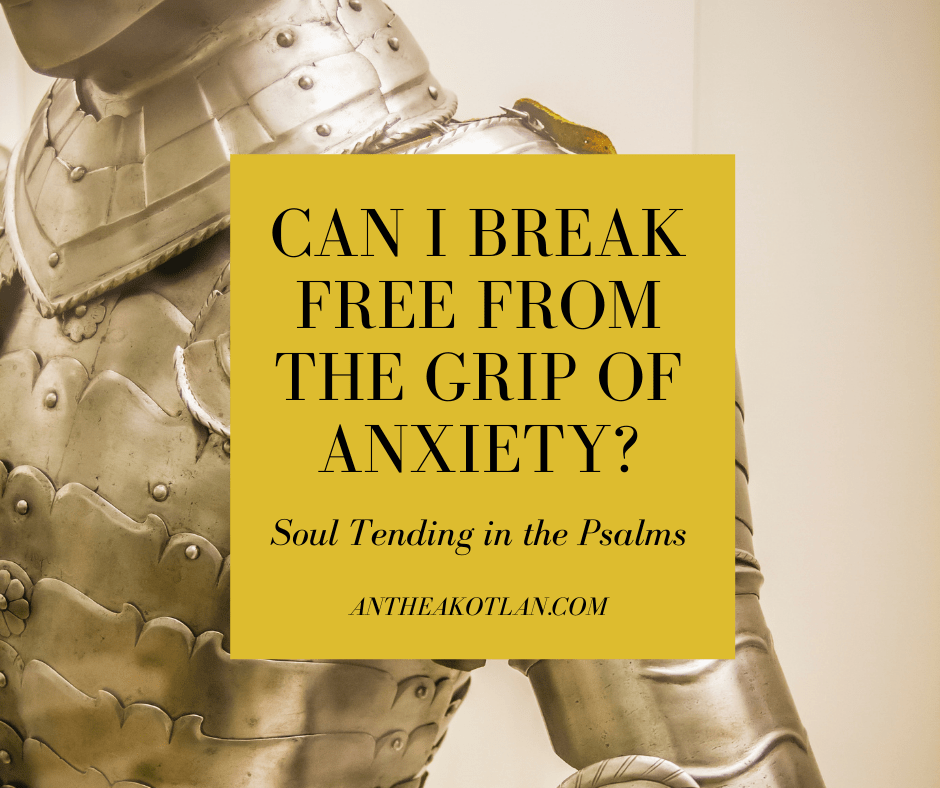
Can I Break Free from the Grip of Anxiety? Psalm 13

The armor of God


The Oxford dictionary defines anxiety as: “a feeling of worry, nervousness, or unease, typically about an imminent event or something with an uncertain outcome.”

My childhood was steeped in a tradition of ominous concern for all outcomes. My mother is particularly gifted in creating worst-case scenarios. She was an apocalyptic prepper long before it became trendy.
Honestly, my inheritance of anxiety has been nourished and watered by me for many years. It’s a hard habit to break. My default setting is to worry first and pray later. I must intentionally surrender my fears and anxieties to God.

Does anxiety have a paralyzing grip on me?

Anxiety leaves me feeling small and weak and quite focused on myself.

Psalm 13 is a psalm of lament. The author feels desperate and without hope. I believe psalms of lament provide a liturgy for processing through feelings of deep sadness and fear. As I read the first two verses of Psalm 13, I notice the author feels overwhelmed with a state of lack and longing. Telling God exactly how I feel is never a problem. Crying out to him provides a chance to process my feelings, and that is the only healthy way to process them.

1 How long, O Lord? Will you forget me forever? How long will you hide your face from me?2 How long must I take counsel in my soul and have sorrow in my heart all the day?How long shall my enemy be exalted over me?
Psalm 13:1-2 ESV

In these opening verses, the psalmist expresses frustration with delay. “How long?” is a question focused on what I don’t have. I want a right now solution. The psalmist focuses on what he believes has not been considered or attended to by God. Have I questioned God’s timing on solving a problem I have prayed about? Choosing to believe that I am not getting what I deserve, and God is neglecting me, may cause me to become spiritually vulnerable to the enemy’s deceptions. I can choose to stop feeding the anxiety beast and stop focusing on what I don’t have.
How long? The real answer to that question is when it’s the best time according to God. The ideal timing of God’s provision for anything I ask for is based on things I don’t even know that I don’t know. Releasing my urgent need to know, brings freedom and peace.

The question in verse 2 feels like it was taken directly from my own life. “How long must I take counsel in my soul and have sorrow in my heart all the day?”

Have I taken counsel or advice only from myself at times? Yes.

I believe that God designed us to thrive in community. Isolation can lead to seeking advice based solely on my own experience. Sometimes I need a fresh perspective from a godly friend or mentor. All too often, isolation can lead to sorrow or even depression. I can feel isolated in a room full of people. One lie that I have believed at times is that I am the only one to have experienced something. Or I am the only one to have made such a terrible mistake. There is very little new under the sun. If I am willing to be vulnerable with a trusted friend or family member, I might find someone else who can help me carry the burden, because he or she has traveled this road as well.
The second part of verse 2 asked about my enemy. Who is my enemy? The person who cut me off in traffic. The family member who betrayed my trust. The church leader who failed me when I needed her help the most. In the pain of the moment, any human may play a role.

Who is our real enemy?

“For we do not wrestle against flesh and blood, but against the rulers, against the authorities, against the cosmic powers over this present darkness, against the spiritual forces of evil in the heavenly places.” Ephesian 6:12 ESV
My true enemy is Satan, and he utilizes spiritual forces that trespass into heavenly places. The good news is that God has provided the ultimate victory for us through the death and resurrection of Jesus Christ.
In Ephesians chapter 6, Paul goes on to challenge us to put on our spiritual armor.
13 Therefore take up the whole armor of God, that you may be able to withstand in the evil day, and having done all, to stand firm. 14 Stand therefore, having fastened on the belt of truth, and having put on the breastplate of righteousness, 15 and, as shoes for your feet, having put on the readiness given by the gospel of peace. 16 In all circumstances take up the shield of faith, with which you can extinguish all the flaming darts of the evil one; 17 and take the helmet of salvation, and the sword of the Spirit, which is the word of God, 18 praying at all times in the Spirit, with all prayer and supplication. To that end, keep alert with all perseverance, making supplication for all the saints…Ephesians 6:13-18 ESV

When do I need to put on my armor?

We are called to suit up daily with the armor of God. Pray through each piece of armor and ask God to provide this for you and those you love. Carefully pray each verse and imagine you are putting each piece on.

  • Fasten on the belt of truth
  • Put on the breastplate of righteousness,
  • Put on the shoes for your feet, the readiness given by the gospel of peace.
  • Take up the shield of faith
  • Put on the helmet of salvation,
  • Carry the sword of the Spirit, which is the word of God

What are the benefits of using the armor of God?

Suiting up with God’s armor will break the grip anxiety has on our minds and hearts. Putting on the armor will also free us up to accomplish some important kingdom-building work.

  • Praying at all times – continually praying throughout the day and night
  • Praying in the Holy Spirit – letting God guide our prayer agendas • Keeping alert –avoiding distractions
  • Persevering— keep going• Receiving a renewed opportunity to pray for other Christians

Prayer

Thank you, Lord, for your provision in times of fear and uncertainty. It is far too easy for me to allow anxiety to overwhelm and isolate me. Help me to cry out to you first and foremost. Help me to seek God’s counsel from friends and family. Remind me daily to put on the spiritual armor you have so generously provided. Help me to walk daily in greater freedom by surrendering every fear to you. In Jesus’ name, Amen.

Are You Giving Margin for Lament? Psalm 42

(Actual photo of the deer that treat my front yard as a salad bar.)

Everyone I know experienced loss in 2020. Job loss, death, illness, cancellation of special events, long months of separation from loved ones, financial struggles, depression, strain on marriages, anxiety and more was served up in abundance to everyone.

What do I do when faced with a sad situation, a significant loss or a painful transition?

I believe there is a need, hard-wired into our soul, to grieve, process and lament pain. Stuffing it down only lengthens the healing pathway or avoids it entirely.

Psalm 42 is written as a lament. It begins with the vivid picture of thirsty animal.

1As a deer pants for flowing streams, so pants my soul for you, O God.
My soul thirsts for God,
 for the living God. When shall I come and appear before God?

Psalm 42:1-2 ESV

The Master Designer of humans created me with a need for Him. My soul literally thirsts and hungers to be in God’s presence. Far too often shame, guilt, sadness, and depression keep me from running to the only one who can fill my needs. I might even try to satisfy myself with people and things, but only God can water my parched soul.

My tears have been my food day and night, while they say to me all the day long, “Where is your God?”
These things I remember, as I pour out my soul: how I would go with the throng and lead them in procession to the house of God with glad shouts and songs of praise, a multitude keeping festival.

Psalm 42:3-4 ESV

In times of deep grieving my tears have truly been my food day and night. Sometimes well-meaning friends offer empty platitudes or pointed questions that provide no hope or encouragement. While I long to gather in God’s house, I’m pouring out what little energy I might have left on my grief journey. The steps in processing grief must be taken one by one. Rushing back into a festival or celebration would be disorienting until the work of grieving in completed.

Why are you cast down, O my soul, and why are you in turmoil within me?
Hope in God; for I shall again praise him, my salvation
and my God.My soul is cast down within me; therefore, I remember you from the land of Jordan and of Hermon, from Mount Mizar.

Psalm 42:5-6 ESV

Part of any grieving journey requires some soul searching and an exploration of why. My own feeling sometimes surprises me. My hope is found in God and that is a handhold in the dark way that must be traveled. Can I call to mind times of God’s faithfulness in my life? Making a list might bring a fresh spring of encouragement. The psalmist recalls the unchanging landmarks in the land where he lives as he travels the uncertain territory of processing grief. What are the places where God has shown himself large and active in my life? Shall I place a stone of remembrance there to bear testimony of what He has done for me?

Thank you, God that you provide a map for traveling the pathway of grieving. You give abundant margin for me to bring all my deepest and darkest feelings to you. You are always available to hear my cries. You never tire of reminding me of what you have done for me. Help me to travel the grieving pathway at your pace. Not running ahead or giving up but moving ever forward to great healing that can only come from you. AMEN

How do you leave margin to process grief? I would love to hear your thoughts.

Leaving Room for Lament

Leaving Room for Lament

I listened to a wonderful podcast recently from Annie F. Downs (Episode #221) as she interviewed Pastor Eugene Cho. Cho talked about a need to lament in this season of Corona virus.  Have you given yourself permission to lament lately? Pastor Cho asked.

I think it is challenging to make room for lament in a culture that encourages us to move on, avoid, and move past suffering. Who wants to get stuck in suffering’s waiting room?

What is lament?

Lament is a form of prayer where we cry out to the Lord and express our pain point. We see this modeled in the Bible. One third of the Psalms were written in the lament form. There is actually a whole book of Lamentations in the Bible. Even Jesus lamented from the cross in Psalm 22. A great study on lament is tucked into the book of Job. There we see poor Job experience the worst losses perhaps anyone has ever experienced.

In chapter one, Job loses everything. He loses all his adult children, most of his servants, all his livestock, and everything else he owned. Almost all that filled Job’s life to overflowing was systematically wiped out with a brutal efficiency.

After this, Job opened his mouth and cursed the day of his birth. He said: “May the day of my birth perish, and the night that said, ‘A boy is conceived!’ (Job 3:1-3 ESV)

In this chapter Job launches a volley of questions and laments in a long procession that makes room for the grief he is experiencing. He needs to do this. He must unload the weight of all he is experiencing in the ultimate safety that exists in the sacred space we occupy with God when we pray.

Human nature is to blame others. We try to move as far away from our pain and what we perceive to be its source as is possible. We make excuses and create distance. We try to numb our pain with food, alcohol, busyness, screen time, escape. These avoidance techniques can look different for everyone.

We want to short-circuit the grieving process and not sit in our pain. We want to move on and run to the next experience. When we do these things, we miss an opportunity for growth. Job laments his pain and spews it out word after painful word.

Many of us have experienced loss during this pandemic. Pastor Cho encourages us to work through our losses by naming them and bringing them into the light. This is necessary, explains Cho, because we try ignoring them, excusing them away, minimizing them by comparison, (it wasn’t as bad as someone else’s loss), stuffing them, obsessing on them. None of that is healthy. Cho suggests we make a list with the Lord. Write the losses and disappointments down and then tell God about them. He already knows, but you will be blessed by doing this. Ask the Holy Spirit to remind you of the losses you may have lost track of. You might even have losses that you haven’t allowed yourself to even think about. Process through your pain. Failure to do this will result in your spiritual growth getting stunted. In this season, leave room for lament.

Prayer

Blessed are those who lament because you promise in your Word God that we will receive comfort. I ask that you bring a blessing of comfort as we take time to lament our losses. We desperately want to grow and bring honor and glory to you. We want to be strong so we can offer comfort to others from the overflow of all we have received from you. Amen